
Hamradiomaster may earn a commission from Amazon purchases — at no extra cost to you. Our recommendations reflect our team’s evaluation, not affiliate payouts. Full disclosure →
Complete Ham Radio License Levels Buying Guide for 2026
The FCC licenses amateur radio operators through three progressive levels, each unlocking broader frequency privileges and operating modes. Understanding the differences between Technician, General, and Extra class licenses helps aspiring hams choose the right starting point and plan their upgrade path. In 2026, exam requirements remain accessible while offering clear advancement opportunities for dedicated operators.
Each license level requires passing a written exam with no Morse code testing needed at any tier. The Technician class opens VHF/UHF privileges perfect for local communications and emergency service. General class adds extensive HF bands for worldwide contacts. Extra class grants full amateur radio privileges across all frequencies and modes. Our team has analyzed current test requirements and frequency allocations to help you understand what each level offers and which equipment best matches your license class.
What This Guide Covers
- License Types & Classes
- Key Features & Privileges
- Common Licensing Mistakes
- Equipment Recommendations by License
- Frequently Asked Questions
Types to Know Before You Buy
Technician Class License
Entry-level amateur radio license requiring a 35-question exam covering basic regulations, operating practices, and electronics theory. Grants all amateur privileges above 30 MHz including VHF, UHF, and limited HF phone privileges.
Pros
- Easiest exam with 35 questions from a published pool
- Full VHF/UHF privileges for repeaters and local communications
- Access to all amateur satellite operations
- No Morse code requirement
Cons
- Limited HF privileges restrict long-distance communications
- No access to popular 80m, 40m, and 20m phone bands
- May require upgrade for DX and contest participation
General Class License
Intermediate license requiring a 35-question exam covering HF operating practices, additional regulations, and intermediate electronics. Unlocks major portions of all HF bands for voice, digital, and CW operations worldwide.
Pros
- Access to major portions of 160m through 10m HF bands
- Worldwide communication capabilities via HF propagation
- Eligibility for DX contests and awards programs
- Retains all Technician privileges
Cons
- Some band segments remain Extra-class only
- Requires passing both Technician and General exams
- Limited phone privileges on certain bands below 28 MHz
Extra Class License
Highest amateur radio license requiring a 50-question exam covering advanced regulations, operating practices, and technical topics. Grants complete access to all amateur frequencies and modes with no restrictions.
Pros
- Full privileges on all amateur radio bands and modes
- Access to exclusive Extra-class band segments
- Highest level of technical knowledge certification
- Prestige within amateur radio community
Cons
- Most challenging exam with advanced technical content
- Requires passing all three license exams in sequence
- Practical benefits over General are limited for casual operators
- Study time commitment typically 40-60 hours
Club Station License
Organizational license allowing groups to operate under a club callsign, requiring at least four members with one holding a General or higher license as trustee. Enables shared station operation and community outreach programs.
Pros
- Shared operating expenses among club members
- Single callsign for group activities and contests
- Educational opportunities for new operators
- Potential for advanced station equipment pooling
Cons
- Requires ongoing club membership and organization
- Trustee assumes regulatory responsibility
- Station privileges limited to control operator’s license class
- Administrative overhead for maintaining club structure
Key Features to Evaluate
VHF/UHF Band Access
All license classes receive full privileges on frequencies above 50 MHz including 6m, 2m, 1.25m, and 70cm bands. These frequencies support local repeater networks, FM simplex communications, and satellite operations essential for emergency services and community nets.
HF Phone Privileges
General and Extra classes unlock voice operations on HF bands (3-30 MHz) enabling worldwide contacts via skywave propagation. General operators access major phone segments on 80m, 40m, 20m, 15m, and 10m, while Extra class removes all phone restrictions across every band.
Digital Mode Authorization
All license levels permit digital modes including FT8, PSK31, RTTY, and packet radio within their authorized frequency segments. Technician operators enjoy full digital privileges on VHF/UHF, while General and Extra classes add HF digital bands for long-distance data communications and weak-signal work.
CW Operating Privileges
Morse code operation is permitted at all license levels within authorized segments, with Technician class limited to HF CW-only subbands. General operators gain significant CW privileges across HF bands, and Extra class receives complete access to exclusive CW DX windows on 80m, 40m, 20m, and 15m.
Power Output Limits
Technician and General classes operate at maximum 1,500 watts PEP on most bands, with 200-watt limits on specific HF Technician segments. Extra class maintains the same power limits but gains access to additional frequencies. Novice-era power restrictions no longer apply in 2026 licensing.
International Operating Recognition
General and Extra class licenses qualify for CEPT and reciprocal operating agreements in over 100 countries, allowing foreign operation without additional licensing. Technician operators face more limitations for international reciprocal privileges, though some countries accept all three classes under bilateral agreements.
Common Mistakes to Avoid
Recommendations by Budget
Budget Technician Setup
$150 – $300Entry-level VHF/UHF equipment perfectly matched to Technician class privileges for local repeater access and simplex communications.
 Top Pick Budget Technician Setup
Baofeng UV-5R Dual Band Handheld Radio
The UV-5R remains the most popular first radio for Technician operators in 2026, covering 2m and 70cm bands with 5 watts output. Despite its low cost, it delivers reliable repeater access and simplex communications with programmable memory channels and dual-watch functionality. Includes rechargeable battery, antenna, and desktop charger for complete out-of-box operation.
Check Price on Amazon Extended Range
Nagoya NA-771 Antenna Upgrade
Replaces stock antenna with 15.6-inch whip providing noticeable improvement in signal reception and transmission range on VHF/UHF bands.
Check Price on Amazon Memory Management
Programming Cable for UV-5R
USB cable with CHIRP software compatibility allows computer-based frequency programming, essential for loading repeater channels and organizing memory banks efficiently.
Check Price on AmazonMid-Range General Class Setup
$800 – $1,500Complete HF station supporting General class privileges across major bands for domestic and international voice, digital, and CW operations.
 Top Pick Mid-Range General Class Setup
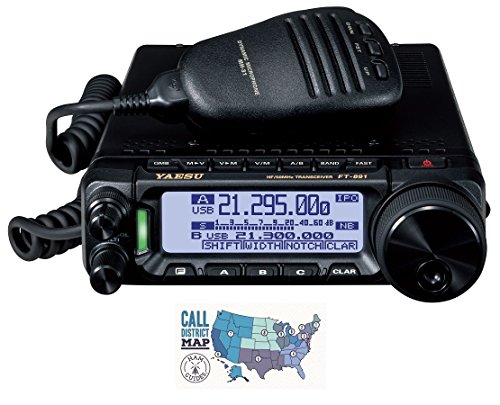
Yaesu FT-891 HF/50MHz Mobile Transceiver
The FT-891 delivers 100 watts across all HF bands plus 6 meters, perfectly matching General class phone and digital privileges. Built-in automatic antenna tuner handles impedance matching for wire antennas and mobile whips. High-resolution color display, USB/LSB/CW/AM/FM/C4FM modes, and DSP filtering provide excellent receive performance. Compact size suits both home stations and portable operation for field events and emergency deployments.
Check Price on Amazon Multiband HF
MFJ-1984LP EndFed Halfwave Antenna
Single-wire antenna covering 80m through 10m with low-profile installation requires no tuner, ideal for General class operators in restricted spaces or portable deployments.
Check Price on AmazonPremium Extra Class Setup
$2,500 – $5,000Professional-grade station maximizing Extra class privileges with advanced DSP, full-band coverage, and contest-ready features for serious DX and competition operation.
 Top Pick Premium Extra Class Setup
Icom IC-7300 HF/50MHz Base Transceiver
The IC-7300 revolutionized amateur radio with direct-sampling SDR technology, offering exceptional weak-signal performance across all HF bands and 6 meters. Built-in spectrum scope displays band activity in real time, while advanced DSP filtering extracts signals from crowded contest pileups. Touchscreen interface, 100-watt output, and USB connectivity for digital modes make this the preferred choice for Extra class operators pursuing DX awards. Internal automatic antenna tuner and multiple receiver options handle everything from CW to FT8.
Check Price on Amazon DX Clarity
Heil PR-781 Studio Microphone
Professional-grade dynamic microphone with tailored frequency response cuts through pileups, giving Extra operators competitive advantage in DX chasing and contests.
Check Price on Amazon Full Privileges
SteppIR DB18E 3-Element Yagi
Motorized element antenna automatically adjusts for 20m through 6m, providing directional gain across Extra class exclusive segments without band-switching.
Check Price on AmazonFrequently Asked Questions
No, FCC regulations require sequential testing. You must pass the Technician exam before attempting General, and both Technician and General before Extra. However, many exam sessions allow you to take multiple exams in one sitting, so you can potentially earn General or even Extra class on your first test day by passing exams sequentially.
All amateur radio licenses are valid for 10 years from the grant date. Renewal is free through the FCC website starting 90 days before expiration. If you let your license expire, you have a 2-year grace period to renew without retesting, but you cannot operate during this grace period.
Technician class operators have CW-only privileges on portions of 80m, 40m, 15m, and 10m bands, plus limited phone privileges on 10m above 28.300 MHz. These restrictions mean Technicians cannot use voice on popular 20m, 40m, and 80m phone segments where most HF activity occurs, making General upgrade valuable for operators wanting regular HF phone contacts.
For casual operators, Extra class offers limited practical benefits beyond General. The main advantages are exclusive CW/digital segments on some bands and the prestige of holding the highest license. General class already provides access to 83% of HF phone spectrum and most contesters and DXers successfully operate with General privileges. Extra makes sense if you’re deeply involved in contesting, want the technical challenge, or need specific band segments for specialty operating.
No, the FCC eliminated Morse code testing requirements in 2007. All three license classes use written multiple-choice exams only. However, CW (Morse code) remains a popular operating mode, and learning it opens additional frequency privileges and improves your technical skills even though it’s not required for licensing.
Most people pass Technician with 15-25 hours of study using question pool software and basic theory materials. General typically requires 25-35 hours, building on Technician knowledge. Extra demands 40-60 hours due to advanced math, complex circuit theory, and detailed regulations. Before beginning your preparation, review detailed information in our license test overview to understand exam format and question distribution.
General and Extra class licenses qualify for reciprocal operating privileges in countries that participate in CEPT agreements or have bilateral treaties with the US. Technician operators face more restrictions, though some countries accept all three classes. You typically need to carry your original license, understand the host country’s regulations, and may need to use a special call sign format combining your US call with the foreign prefix.
You can retake any failed exam at the next test session without waiting periods, though you’ll pay another exam fee. Most volunteer examiner teams schedule sessions monthly or quarterly. Many candidates use practice resources like our realistic practice exams to identify weak areas before retesting. The question pools are public, so focused study on missed topics typically leads to success on the second attempt.